
The recipe is right below, together with some pictures to show the steps:
This is for the full recipe, I only made half recipe this time. For yam pastry, just replace the pandan paste with yam paste, and the filling to yam(steam yam, mash while hot and add in sugar to taste)
Water Dough (A)
200g plain flour }sift
28g icing sugar }
80g cold butter
80g water
Cut butter into flour mixture using fingertips or pastry blender until mixture resembles breadcrumbs. Add in water and mix to form a soft, non-sticky dough. No need to knead. Cover and set aside to rest for 20 mins.
Oil Dough (B)
180g plain flour, sifted
90g oil (I use canola)
½ tsp pandan paste
Make a well in the centre of the flour and add in oil and pandan paste. Draw in the flour from the sides and mix to form a soft even coloured dough. So not over-mix. Cover and set aside for 20 mins.
300g green bean paste filling (C)
To assemble:
1) Divide (A) and (B) each into 10 equal pieces – Pic 2, and (C) into 20 pieces. 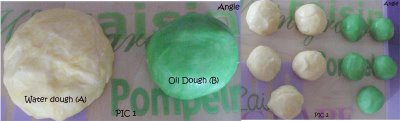
2) Taking one piece of (A), flatten and wrap (B) in it. Pinch to seal edges – Pics 3 & 4.
3) With the sealed side facing up, roll into a rectangle – Pic 5
4) Roll up to form a ‘cylinder’, turn the cylinder 90 degrees, with the end facing up – Pics 6 & 7.

5) Roll again into a long thin strip – Pic 8. Roll the strip into a short fat cylinder – Pic 9.
6) Using a sharp knife, cut the cylinder into two pieces. Pic 10 shows the cut side up. Cover and set aside to rest for at least 10 mins.
7) With the cut side facing down – Pic 11, flatten the dough, making the edges slightly thinner than the centre. Wrap the filling and pinch to seal – Pic 12. Try not to 'tug/pull' too hard, otherwise the layers will tear. Best to flatten the dough larger than smaller so it's easier to pinch 8) Place sealed side down - Pic 13 on lined baking tray and bake in preheated 185C for about 30 mins until the top and bottom are a light golden brown.
I'm no expert in these pastries, just gathered some points from the two attempts and from some reading up. Please bear with my long-windedness
Note 1: this type of pastries usually uses lard (most traditional) or shortening or even ghee to achieve a very flaky pastry. The original recipe uses shortening. As I am not a big fan of that, I used a combination of butter and oil (so far I haven't seen recipes that uses two different types of fats). For me, I find the flakiness is just right, with a light buttery fragrance. You can always try shortening.
Note 2: Do keep the dough(s) covered with plastic wrap while resting/waiting for their turn, to prevent drying out.
Note 3: when rolling out the dough, try not to press too hard on it. Same as when rolling into a cylinder, it doesn't have to be very tight. These will affect the texture of the finished product, resulting in a hard pastry and the layering effect will not be nice.
Note 4: If you find that the pastry has turned slightly soft the next day, just pop into the oven toaster to reheat for a few minutes and they will be as good as fresh.
Besides these, I also had a totally home-cooked lunch on Saturday. Using my pasta machine, I made wanton noodles using recipe from a KC member. To make it a complete 'package' like those sold outside, I made char siew using Gina's recipe. Even the wanton you see are wrapped by me, though I failed in the attempt to make the wanton skin. So here is my home-made wanton mee.


12 comments:
Angie,
Thanks for the step-by-step pictures guide, a lot of work. But this spiral pandan pastry looks prettier.
Your wontan noodles looks delicious too!
Wow! Sifu of Chinese Pastries!
Ching, thanks. Paisei the pics a bit small, hope can see. Prettier, likely due to the pastel green ;p
Eve, no lah, you so kind with your words. Hopefully I haven't bore you all to death with all these pastries.
Wow wow wow... U are really good!!! *Salute* They look so beautiful & (once again) PROFESSIONAL.
Thanks for your complimwnts Fonia :)
Angie, you have been tagged to write a Meme. Please check my blog : http://tazzinthekitchen.blogspot.com/2006/04/foodbloggers-meme-around-world.html
:)
Angie,
Peek-a-boo (hehee...)
Just love the pics and the presentation! Very "japanese" to me.
Me too, tend to bake/make the same thing over and over until the thing's done perfectly. It helps me to understand what problem will occur at which circumstance. This knowledge I learnt sort of becomes my second nature, so when I bake it again in the future, basically I don't need to "consult" the book anymore. Not sure if you have the same feeling.
I just love your pastry and want to try out.
giselle
Giselle, thanks for 'peeking-a-boo', hee. You are right, I'm quite like you too, I can't get over it if I can't find out the problem behind the failure. Recently having some problems with chiffon cakes, stilll trying to 'dig out' the cause.
Looking forward to seeing your pastry, please take your time ya ;p
oh wow! i love the look of those pretty spiral flaky pastries (:
haa im tempted to try e recipe out myself but ive got a qsn! i want to make one with yam but what do you mean by 'yam paste'? where can i get it? thanks in advance!! (:
Hi cyr_daze,
Thanks for your compliments. Regarding yam paste, it's a thick purple liquid. In the baking needs section, it's usually placed with those flavourings and colorings. Are you in Singapore? If so, you can find this easily in Phoon Huat. If you really cannot get this, you could use purple food colouring, but you'll lose a bit of the yam flavour (yam paste gives both flavour and color). Hope this helps :)
Hi, Wanna ask which is your fav baking book :
Donna Hay
Jamie's Kitchen
How to be a Domestic Goddness
Baking from my home to yours
As i'm thinking to get one
Thanks!
simonneho@yahoo.com
Hi the lady who bakes,
I personally prefer the 4th book from Dorie Greenspan.
Post a Comment