Friday, April 20, 2007

Legend of the Dragon?

I just realized that I’ve been posting about fruits for the past two Weekend Herb Blogging. Well, these lovely fruits seems to be taking turns to appear on the supermarket shelves. It’s really difficult to walk past them without transferring one or two packs into my shopping trolley.

This week’s WHB is no exception (sorry, I guess the above is just an excuse for my lack of ideas). Hosted by our lovely Sher this week, to entice her (hopefully), I thought a glorious-coloured fruit might do the trick.

Here I present the dragonfruit – also known as pitaya and 火龙果.

These are fruits of the cactus species, and the ‘scaly’ skin encloses a soft flesh studded with many black seeds, similar to those in a kiwi fruit. There are three varieties - pinkish skin with white flesh, pinkish skin with red-purplish flesh, and the last is yellow skin with white flesh. Dragonfruits are native to Mexico as well as Central and South America, but are also cultivated in asian countries now, with Vietnam being a major exporter of the fruit(Anh, correct me if I’m wrong :p).

I didn’t like dragonfruits at all previously, because I find the taste too bland for my liking. That was until I tried the red-fleshed variety. It was sweeter than the white-fleshed fruits, and I began to appreciate the subtle sweetness of this fruit, and the crunchy black seeds too.

The best and easiest way to enjoy this fruit is to cut it into half(chilled it well first), scoop out the flesh and enjoy it by the spoonful. But that’s so ‘not-interesting’ for this post right? So digging into my fridge ……………..I found kiwi fruit…..wait wait…..and pineapple. Okay, cube these fruits and pile them into the ‘shell’ left behind from the scooping. So here is my colourful Dragon Boat.

Please don’t forget to visit Sher for the re-cap of all the entries, and of course hop over to Kalyn’s Kitchen for more details on WHB.

Sunday, April 15, 2007

Sweet and Simple

It's time for Weekend Herb Blogging again. For those who would like to join this weekly blogging event, whereby bloggers write about herbs, fruits, vegetables or even flowers, don't forget to check out Kalyn's Kitchen, where it all started. This week, the guest host is talented Haalo from Cook (Almost) Anthing At Least Once.

I picked up a packet of Seckel pears from the supermarket. Seckel pears are also known as sugar pears. As you might have guessed from the name, these pears are very sweet, and juicy as well. Another characteristic of these is the blushes of maroon on the green skin. They are also smaller in size than the usual ones such as Anjou or Bartlett.

I polished off two pears in one sitting. With the rest, I decided to poach them. With the recipe for Classic Poached Pears from Donna Hay, I made this:
Below is my recipe, which is a pretty major adaptation, because I changed the wine from red to white. As I do not like red wine, I didn't want to spend on a bottle of wine to be used only for this. That is also the reason for the light pink shade of these pears instead of the deep red hue.

Poached Pears
250ml sweet dessert wine (I used Muscat)
250ml natural red grape juice
50g sugar
1 cinnamon stick
1 clove
5 Seckel pears, peeled, leave stalks intact

1) Heat all ingredients except pears in a pot over medium heat, until sugar is dissolved. Turn heat to low and simmer this liquid for 5 minutes.
2) Add in the pears. Over low heat, simmer the pears, covered, for about 30 minutes.
3) Remove from heat, let cool. Refrigerate the pears in the syrup overnight before serving.

Sunday, April 08, 2007

"Food Thoughts"

Recently my blogger pal Gattina made a pasta dish using cuttlefish ink spaghetti. It is a very pretty dish, but Gattina had some thoughts – since squid ink neither enhances the taste, nor the colour of the spaghetti, why add it in in the first place? Yes, why? Perhaps for novelty? Or to make a more interesting dining experience?

It also set me thinking, though on a slightly different mode, how you ever wondered how some foods can be ‘offensive’ in their own ways? Yet we cannot resist their charm and simply adore them to bits. By ‘offensive’, I mean the smell in particular. Just think the widely-eaten cheese(especially blue cheese), or the Chou Dou Fu a.k.a ‘smelly beancurd’ commonly sold in Hongkong and Taiwan, and natto – fermented soyabeans, Japanese style

Of course, one man’s meat is another’s poison. Afterall, taste is a very personal thing, and also changes with time. Like myself, I used to hate cheese, but over these few years, I’ve learnt to appreciate them, though blue cheese is still one that I can’t stomach.

Before I digress further, I better come back to this post, dedicated to Weekend Herb Blogging. This week’s WHB is hosted by the talented Anh, who never fails to amaze me with her creations, especially those reflecting her Vietnamese heritage. Of course, don’t forget to check Kalyn’s Kitchen for more details on WHB.


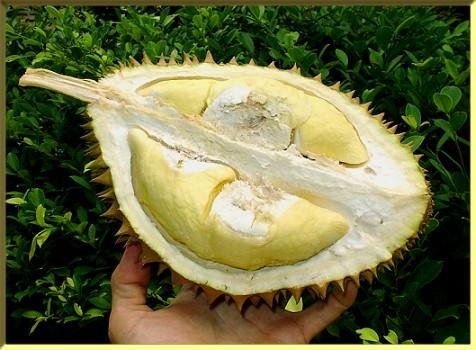
Okay, here I present a really smelly fruit – durians. A tropical fruit with a thorny husk, durians are very popular in Asian countries such as Singapore, Malaysian and Thailand. Used in a variety of desserts such as cakes, puddings and ice creams, durians represents a true ‘love-hate’ with many people. You would either love it or hate it, there is no ‘in-between’. This of course stems from the pungent odour from durians, which have been described in various colourful terms – garbage truck, unwashed sneakers, rotting fish etc. But if you can get pass the smell barrier, the flesh of durians is actually very rich, creamy and sweet (some varieties have a slight bitterness, which helps to enhance the taste).

I managed to buy some pre-packed(flesh removed and packed) durians from the neighbourhood supermarket, and hence I don’t have a picture of the whole fruit. For a look at the thorny fruit, click here.

A look at the seed:
Using the cream puff recipe from Florence, I made my first batch of puffs. Yes, so many years of baking and I’ve never attempted choux pastry. It was interesting to see these baking in the oven, because they amazingly puff to almost thrice the height, and yet they are hollow in the centre.

Instead of cream, I filled these with durian instead. I just removed the flesh from the seeds, pass them through a sieve to remove the fibres. I did not add any cream or milk, so it’s pure, unadultered, creamy durian in these light-as-air puffs.

Thursday, April 05, 2007

After a Long Hiatus...

..... Here's 'Rocky Road':

Hey there friends, before you think I've disappeared, I thought I better update my posts. Sorry, but I've been really tight up with work, with over-time hours and on some weekends as well. My energy levels are at the lowest by the time I reach home and so as expected, no baking, which equals nothing to blog about.

As the saying goes "Old Habits Die Hard", so here I am with Nigella Lawson's brownies, recipe from How To Be a Domestic Goddess. With brownies, I like mine dark and fudgy, and this fits the bill perfectly. But this recipe, I must say, is not for the faint-hearted. Looking at the amounts of butter, chocolate and sugar is sufficient to clog one's arteries. However, for the rare occasion, cut it into small bites, and these will make a very delish treat.

If you're interested in the recipe, I found it here. I simply scaled down to half the recipe and used a square baking pan. Do adjust the sugar amounts too, depending on the chocolate you use.

Friday, March 16, 2007

A Sweet Root

Potatoes, tapioca(cassava), yam(taro), artichokes - what do these have in common? They are all placed into the group of root vegetables. Actually it is only when I started 'researching' for this post that I found out that there are so many different types of tubers which are all categorized into this big group, but are actually from various parts of the plant. For more info, check out this from Wikipedia.


For this week's Weekend Herb Blogging, I'm using a starchy root - sweet potato. I think in some countries, sweet potato is called yam. But over here, it is easy to distinguish between these two tubers - yam is usually light purple and stubby, while sweet potato can range from white to yellow to orange, and with tapered ends. In many asian countries, sweet potatoes are widely used in making desserts and sweet 'cakes' like ondeh-ondeh(sweet potato balls with palm sugar filling) and other kuih-kuih.

Here I'm using orange sweet potato to make a sweet dessert - Sweet Potato Soup. It's very simple to prepare with a few ingredients and takes less than half an hour to cook. Sorry for the lack of exact measurements, since the amount of ingredients really depends on your taste and liking.

Sweet Potato Soup

1 sweet potato (about 350g, unpeeled weight)
A handful of dried longans
Some dried red dates
A small knob of ginger, peeled
4 to 5 blades pandan leaves, washed
About 2.5 litres water
Rock sugar or castor sugar

Peel sweet potato, wash and cut into cubes. Rinse dried longans and red dates. Pound red dates slightly(I use the handle of a cleaver). Place all the ingredients into a pot and bring to a boil. Lower heat to medium-low and cook until the sweet potato cubes are soft(about 15 to 20 mins). Discard pandan leaves and add sugar to taste. Serve hot, or chill for a refreshing dessert.


Don't forget to head over to Becky's from Key Lime and Coconut for the re-cap, where she's hosting this weekly event for this week. Of course, always remember to hop over to Kalyn's Kitchen for more details on WHB.

Sunday, March 11, 2007

A New 'Member' & An Old Favourite

I had a new addition to my recipe collection lately - Nigella Lawson's How to be a Domestic Goddess. When blog-hopping, I had come across several good reviews on her recipes, which made me confident about buying this book. I had not gone to search for it intentionally, but as I was browsing at Harris, I saw two copies sitting prettily on the shelf, as if calling out "Buy me, buy me!". Oh well, buy I did :p

I hadn't quite finished reading through the recipes. But I wanted to try out something simple and quick to make. So I chose a scone recipe and modified it for my post for this week's Weekend Herb Blogging, where the guest host is Anna from Morsels and Musings. If you would like to join this weekly event where bloggers write about herbs, flowers, fruits or plants, don't forget to hop over to Kalyn's Kitchen for more details!


Rosemary is my very favourite herb, I simply love the intoxicating aroma it produces during the baking/cooking process. Some people find the pine-like fragrance a bit pungent, but it suits me just fine, in fact, I tend to add more than the recipes ask for. Rosemary has several health benefits to. This is what WHFoods writes about rosemary - rosemary contains substances that are useful for stimulating the immune system, increasing circulation, and improving digestion. Rosemary also contains anti-inflammatory compounds that may make it useful for reducing the severity of asthma attacks. In addition, rosemary has been shown to increase the blood flow to the head and brain, improving concentration.

However, I just realized that I hadn't actually written a WHB post about it yet. How could I have forgotten to do that?! So my apologies, Miss Rosemary. So here I'm pairing rosemary with cheese in these savoury scones.


If you love buttery scones, these would probably not suite your taste. If you look at the recipe below, the amount of butter is actually pretty low for 250g of flour. But I like it that it's light and soft, with each bite perfumed with the taste of cheese and rosemary.

For a more indulgent treat, serve these warm, with a slab of butter on top.

Rosemary and Cheese Scones(modified)

240g plain flour
½ tsp salt
1 tsp bicarbonate of soda
2¼ tsp cream of tartar
1 tbsp fresh rosemary leaves(adjust amount according to your taste)
30g cheese*, grated
40g cold butter, cut into cubes
150ml milk
Beaten egg, for glazing

Method:

1) Sift the flour, salt, bicarbonate of soda and cream of tartar.
2) Using a pastry blender or your fingers, rub in the butter until mixture resembles coarse cornmeal. Add in the rosemary and cheese and mix well.
3) Add in the milk and use a fork to mix briefly.
4) Turn the mixture out onto a floured surface and knead lightly to form a dough. Dough should not be sticky.
5) Roll out (I just pat the dough using my fingers) to about 1-inch thinkness and cut using a 2.5-inch cutter.
6) Place on a lined or lightly-greased baking tray and egg wash the surface. Bake in a preheated 220 C oven for about 20 mins, or until golden brown and risen.

* Nigella’s recipe suggest to use mature cheddar, I used Parmigiano Reggiano.

Scones are best served on the day of baking, especially when fresh from the oven.